
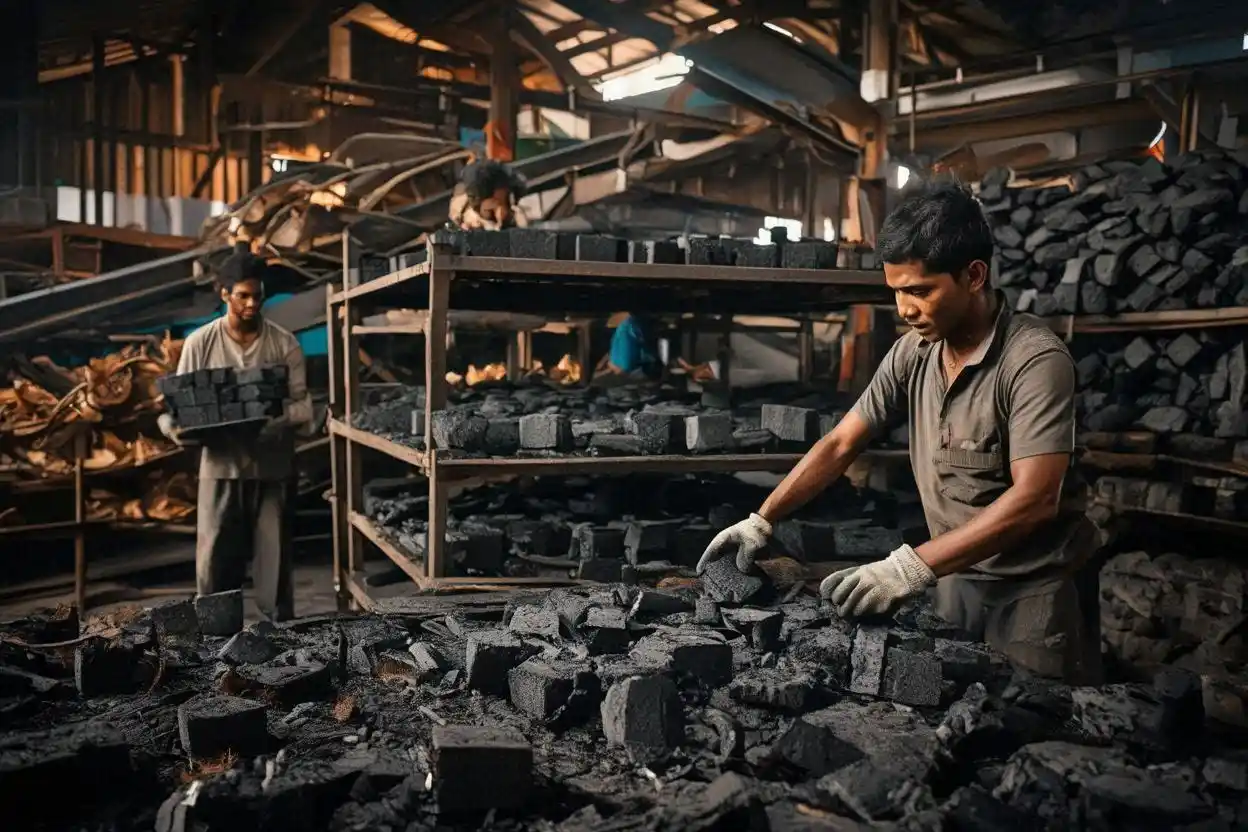
Natural Coconut Charcoal Briquettes Factory Production Guide

March 10, 2026
The demand for sustainable fuel products continues to increase worldwide. Therefore, many businesses now look for a natural coconut charcoal briquettes factory that can provide consistent quality and reliable production capacity.
Coconut charcoal briquettes continue to gain popularity in shisha and barbecue markets. Moreover, these briquettes burn longer and produce less smoke than traditional charcoal, which makes them highly attractive for distributors and retailers.
Natural Coconut Charcoal Briquettes Factory Overview
A natural coconut charcoal briquettes factory converts coconut shell waste into durable charcoal products. First, manufacturers collect coconut shells and process them through a controlled carbonization stage.
After that, the charcoal is crushed into powder and mixed with natural binders. Consequently, the material can be compressed into uniform briquette shapes that burn efficiently and maintain steady heat.
Because coconut shells are natural by-products, this production process also supports environmentally responsible manufacturing.
Coconut Briquettes Factory Production Process
Understanding the production workflow helps buyers evaluate product quality. In addition, professional factories follow structured manufacturing stages to ensure consistent results.
The typical production process includes:
-
Coconut shell carbonization
-
Charcoal grinding into fine powder
-
Mixing with natural binders
-
High-pressure briquette molding
-
Controlled drying and packaging
Each stage influences the density and durability of the final product. As a result, factories with well-managed processes usually produce charcoal that burns longer and performs consistently.
Benefits of Coconut Charcoal Briquettes
Coconut charcoal briquettes offer several advantages for both consumers and businesses. Moreover, their performance often exceeds that of traditional charcoal products.
Some key benefits include:
-
Longer burning duration
-
Stable and consistent heat output
-
Low ash residue
-
Minimal smoke and odor
-
Uniform briquette shape
Because of these qualities, coconut charcoal works well for hookah lounges, restaurants, and barbecue users. Furthermore, many businesses prefer these briquettes for their reliable performance.
Choosing Natural Coconut Briquettes Factories
However, selecting the right natural coconut charcoal briquettes factory requires careful consideration. Buyers should review production standards, quality control systems, and export experience.
Professional factories usually provide detailed product specifications and transparent communication. In addition, experienced manufacturers understand international shipping requirements and packaging standards.
Many importers therefore collaborate with an established coconut charcoal briquette supplier to ensure consistent supply and dependable charcoal performance.
Global Market for Coconut Briquettes
The international demand for coconut charcoal continues to grow. As a result, many distributors search for manufacturers that can support long-term supply partnerships.
Hookah lounges, retailers, and hospitality businesses frequently rely on stable charcoal products. Consequently, factories that maintain consistent production quality often gain stronger positions in global markets.
Entrepreneurs also research industry resources before selecting suppliers. For example, jacoid.com provides various blog references discussing charcoal products, supplier insights, and business opportunities.
These resources help buyers understand production standards and market trends before working with a manufacturer.
Coconut Briquettes Quality Indicators
Before choosing a supplier, buyers should evaluate several quality indicators. These factors help determine whether a factory produces high-performance charcoal.
Important indicators include:
-
High-density charcoal structure
-
Low moisture content
-
Consistent cube size
-
Clean natural raw materials
-
Professional packaging standards
When these qualities are present, the charcoal usually burns steadily and produces minimal ash. Therefore, buyers can distribute the product with greater confidence.
Conclusion
A natural coconut charcoal briquettes factory plays an important role in supplying high-quality charcoal for international markets. By converting coconut shell waste into durable briquettes, manufacturers create fuel products that combine efficiency and sustainability.
Moreover, professional factories follow structured production processes that ensure consistent quality and performance. This reliability helps distributors, retailers, and hospitality businesses maintain stable product supply.
By understanding production methods, quality indicators, and supplier reliability, businesses can make informed decisions when sourcing coconut charcoal briquettes.
