
Borobudur Relief Galleries: Discovering Ancient Stories in Stone

September 29, 2026
The Borobudur relief galleries offer one of the most fascinating ways to understand this ancient Buddhist monument. Stretching across the square terraces, the carved panels present religious stories, moral teachings, historical scenes, and glimpses of everyday life. Exploring these galleries allows visitors to appreciate Borobudur as both an architectural masterpiece and a visual record of the past.
What Are the Borobudur Relief Galleries?
The relief galleries are pathways surrounded by stone walls covered with detailed carvings. They form part of the square terraces that make up the lower and middle sections of Borobudur.
Rather than being separate exhibition spaces, the galleries are integrated into the monument itself. Visitors walk along the pathways while observing the reliefs on the surrounding walls.
This design creates a unique experience because the architecture guides visitors through a sequence of visual stories.
Stories Carved Into the Stone
The reliefs depict a wide variety of scenes. Religious narratives form an important part of the collection, while other panels show people, animals, buildings, landscapes, and activities associated with daily life.
Some carvings illustrate moral lessons and Buddhist teachings. Others provide visual representations of stories connected with Buddhist traditions.
The level of detail makes the reliefs especially interesting. Clothing, architecture, ships, plants, and human activities can all be observed when visitors take time to examine individual panels.
A Journey Through the Galleries
Exploring the Borobudur relief galleries involves more than simply looking at individual carvings. The galleries are arranged as part of the monument’s upward progression.
Visitors can move around a terrace before continuing toward a higher level. Stairways connect the different sections and gradually lead toward the circular platforms above.
This movement creates a sense of progression. The lower galleries contain extensive visual details, while the upper parts of the monument become increasingly open and focused on stupas and Buddha figures.
For a broader explanation of the monument’s structure and meaning, this Borobudur inside guide provides additional information about its reliefs, architecture, and spiritual symbolism.
What Visitors Should Look For
Visitors exploring the galleries can look beyond the main characters in each relief. Small architectural elements and background details often make the scenes particularly interesting.
Look for differences in clothing, transportation, buildings, vegetation, and social activities. These details help demonstrate how the reliefs function as more than religious artwork.
The arrangement of the panels is also worth observing. Repeated decorative patterns connect different sections and contribute to the visual unity of the monument.
Reliefs and Buddhist Symbolism
The relief galleries are closely connected with Borobudur’s broader religious design. The monument’s layout is commonly associated with a spiritual journey, and the reliefs contribute to this experience through stories and teachings.
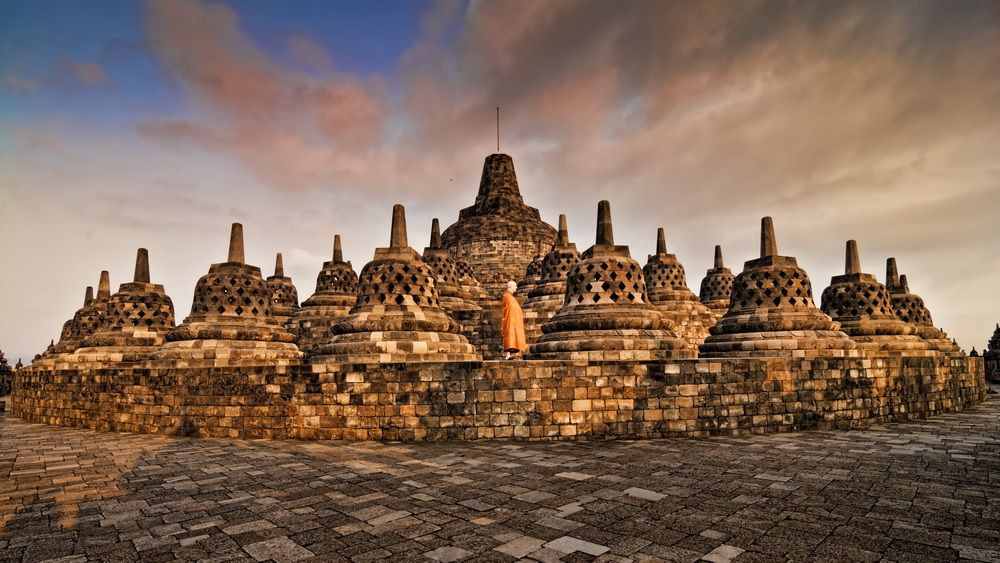
As visitors progress upward, the architectural environment changes. The detailed galleries eventually give way to circular platforms containing perforated stupas and the central stupa.
This relationship between storytelling and architecture makes the galleries an important part of the monument’s overall concept.
Experiencing Borobudur Through Its Reliefs
The Borobudur relief galleries reveal how ancient artists used stone to communicate stories and ideas. Every section offers opportunities to observe different artistic details, from human figures and animals to buildings and symbolic scenes.
Travelers interested in discovering Borobudur and other cultural attractions in Central Java can also explore options through Borobudur Tours.
Taking time to walk through the galleries and observe their carvings can transform a visit into a deeper exploration of history, art, and Buddhist heritage. The reliefs remain one of the strongest features connecting modern visitors with Borobudur’s ancient world.
